“We saved our daughter a projected $1.18 million in taxes by directing her grandfather’s $500,000 IRA to her Special Needs Trust instead of to my wife. You can do the same — even if your child or grandchild doesn’t qualify for disability benefits.”
— James Lange, CPA/Attorney
The above referenced strategy was cited by Ashlea Ebeling in The Wall Street Journal on December 22, 2025, and is described in Jim’s February 2026 Forbes.com article.
Planning for a child or grandchild with a disability or who can’t live independently generally rests on three pillars:
- Securing and preserving eligibility for Supplemental Security Income (SSI) or Social Security Disability Insurance (SSDI) or, when that route is unavailable, determining whether the chronically ill pathway can provide the same favorable stretch IRA treatment for inherited retirement assets;
- Putting the core estate-planning documents in place, including wills, Special Needs Trusts (SNTs), and coordinated IRA and retirement-plan beneficiary designations; and
- Optimizing the income-tax result of the retirement assets you may leave behind.
Who Should Attend?
This webinar is for parents and grandparents of a child or grandchild with a disability or condition that limits independent living — whether or not that person receives SSI or SSDI.
If your child or grandchild already receives SSI or SSDI, Sessions One and Three will be most directly relevant to your planning.
This webinar will also be valuable for attorneys, CPAs, and financial advisors who work with clients who have a beneficiary with special needs.
What If Your Child or Grandchild Doesn’t Receive SSI or SSDI but Can’t Live Independently?
A child or grandchild who qualifies as disabled for SSI or SSDI may qualify as an Eligible Designated Beneficiary (EDB) and stretch distributions from inherited retirement assets over their life expectancy rather than being subject to the usual 10-year rule. Many families don’t realize that someone who does not receive SSI or SSDI, including someone who has been turned down, may still qualify for that same lifetime stretch through the little-known chronically ill pathway.
The term chronically ill sounds much narrower than the rule actually is. Employment does not disqualify someone, and a child or grandchild may function independently in many areas of life while still meeting the applicable requirements.
If your child or grandchild does not receive SSI or SSDI, you should attend all three sessions, particularly if your child or grandchild:
- is on the autism spectrum or has another impairment and, even if employed or relatively independent, still needs regular assistance or supervision to stay on track with important routines, make safe decisions, or respond appropriately when unexpected problems arise;
- has an intellectual disability, developmental delay, cerebral palsy, Down syndrome, or another lifelong condition that limits independent functioning;
- requires supervision to remain safe or is particularly vulnerable without support; or
- needs substantial assistance with certain day-to-day activities.
This information will be covered in Session Two and presented by Andrew H. Hook, CELA, AEP, CFP®, past president of the Special Needs Alliance and one of the nation’s top experts on the chronically ill EDB certification process.
These Strategies Are Simpler Than They Sound
You don’t need to become a tax expert to benefit from these strategies. You need to know the opportunities exist, ask the right questions, and work with professionals who understand how SNTs, beneficiary designations, disclaimer planning, and tax strategy fit together.
This webinar will help you recognize the planning opportunities that may apply to your family and select the right attorney, CPA, or financial advisor to help you put them into practice.

The Million Dollar Disclaim-to-Special-Needs-Trust Strategy
Presented by Jim Lange, CPA/Attorney
This session covers an estate planning strategy designed to help parents and grandparents provide greater lifetime financial security for a child who qualifies as a disabled or a chronically ill EDB. You will learn how naming a SNT as a contingent beneficiary of an IRA, combined with a qualified disclaimer after death, can secure the lifetime stretch instead of subjecting those inherited retirement assets to the SECURE Act’s forced 10-year distribution rule for non-spouses.
Jim used this strategy in his own family and during this session he will show how directing a $500,000 inherited IRA to a SNT for his daughter is projected to save her approximately $1.18 million in taxes over her lifetime.

Please Note:
There will be a short break from Noon to 12:15 PM.

(One registration includes both parts of Session Two.)
Part One: The Chronically Ill Exception: What Every Parent Needs to Know
12:15 – 1:15 PM (Eastern) · Presented by Andy H. Hook, CELA, AEP, CFP®
This session focuses on the little-known chronically ill pathway to EDB status for beneficiaries who do not qualify for SSI or SSDI. No Social Security disability determination is required, and employment by itself does not disqualify someone. This pathway could potentially apply to hundreds of thousands of beneficiaries whose families have never considered them candidates for favorable inherited retirement account treatment.
Andy will explain the two principal ways a beneficiary may qualify, including the substantial-supervision pathway for someone with a cognitive impairment, and how the required certification and documentation process works. He has successfully helped families navigate this process in his own practice and will show parents and grandparents what they and their advisors need to know to determine whether this opportunity may apply to their family.
“By far, the substantial supervision test, the cognitive impairment prong under IRC §7702B(c)(2), is the most common pathway.” — Andrew H. Hook, CELA, AEP, CFP®
Part Two: Questions & Answers with Jim and Andy
1:15 – 1:45 PM (Eastern)
Jim and Andy will take questions from attendees on both strategies and address as many as time permits. Bring your toughest questions, and they will offer their best advice.
Please Note:
There will be a short break from 1:45 to 2 PM.

45 Years of Acquired Wisdom in Two Hours: A War-Weary CPA/Attorney/Financial Advisor Reveals the Lessons Most Relevant for Families Planning for a Child with Special Needs
Presented by Jim Lange, CPA/Attorney
Drawing on 45 years of experience, 10 best-selling books, 37 citations in The Wall Street Journal, and five years hosting a radio show featuring guests such as John Bogle, Bill Bengen, and many of the nation’s leading IRA experts, Jim will distill some of the most important lessons he has learned and explain how parents and grandparents planning for a child or grandchild with special needs can put them to work for their families. His goal is to deliver on a silver platter the most useful lessons from his 45 years of experience.
Over the course of his career, Jim has seen the same retirement and estate-planning mistakes and missed opportunities recur again and again. Some can trigger unnecessary taxes, reduce financial flexibility, or leave less for a surviving spouse or a child or grandchild who may need support for life. In this session, he’ll identify at least seven of the most consequential mistakes he has encountered and explain the planning strategies that can help families avoid them.
Here’s a preview:
- Not knowing how much you can afford to spend. Even families who get their tax and estate planning right (and most don’t) often don’t know how much they can safely spend. Jim will cover Bill Bengen’s updated safe-withdrawal-rate analysis, including planning when your assets may need to last 50 years or more for a child or grandchild with special needs.
- Underestimating the importance of Roth IRA conversions.
- Not understanding the special rules for a SNT that will inherit an IRA or retirement plan. Attorneys are just as guilty as clients in this area. A lot of estate plans are badly botched because IRA owners and their attorneys fail to account for the special rules that apply when retirement assets pass to a SNT.
- Taking Social Security too early, especially for the spouse with the stronger earnings record.
- Failing to include adequate disclaimer provisions in your estate plan or to consider using them after the first death.
- Overlooking Jim’s Who Gets What? strategies for allocating assets among family members in ways that can reduce taxes and improve the amount ultimately available to beneficiaries.
- Not doing the math.

James Lange, CPA/Attorney
Jim is the author of 10 best-selling financial books including Retire Secure for Parents of a Child with a Disability. He has been quoted 37 times in The Wall Street Journal. He is a Forbes.com contributor with more than 20 published articles, including three pieces on planning for families with a child who has a disability, published in the last year, co-developed with Andy Hook—all included in your bonus package. Jim’s daughter, Erica, who has a disability, has benefited from these strategies. Your child can too!

Andrew H. Hook, CELA, AEP, CFP®
Andy is the Past President of the Special Needs Alliance and Former Director of the National Academy of Elder Law Attorneys (NAELA), and former editor-in-chief of the NAELA Journal. Andy is a Fellow of the American College of Trust & Estate Counsel (ACTEC) and NAELA, Founder of the Hook Law Center, Virginia Beach, and co-author of the Special Needs Trust Handbook (Wolters Kluwer). He is now Of Counsel at Hook Law Center and has more than 50 years of legal experience.
Free Bonuses
(Bonuses are available to all who register, even if you are unable to attend our live webinar.)
Register at DisabledChildPlanning.com/2026Webinar and receive the following bonuses:
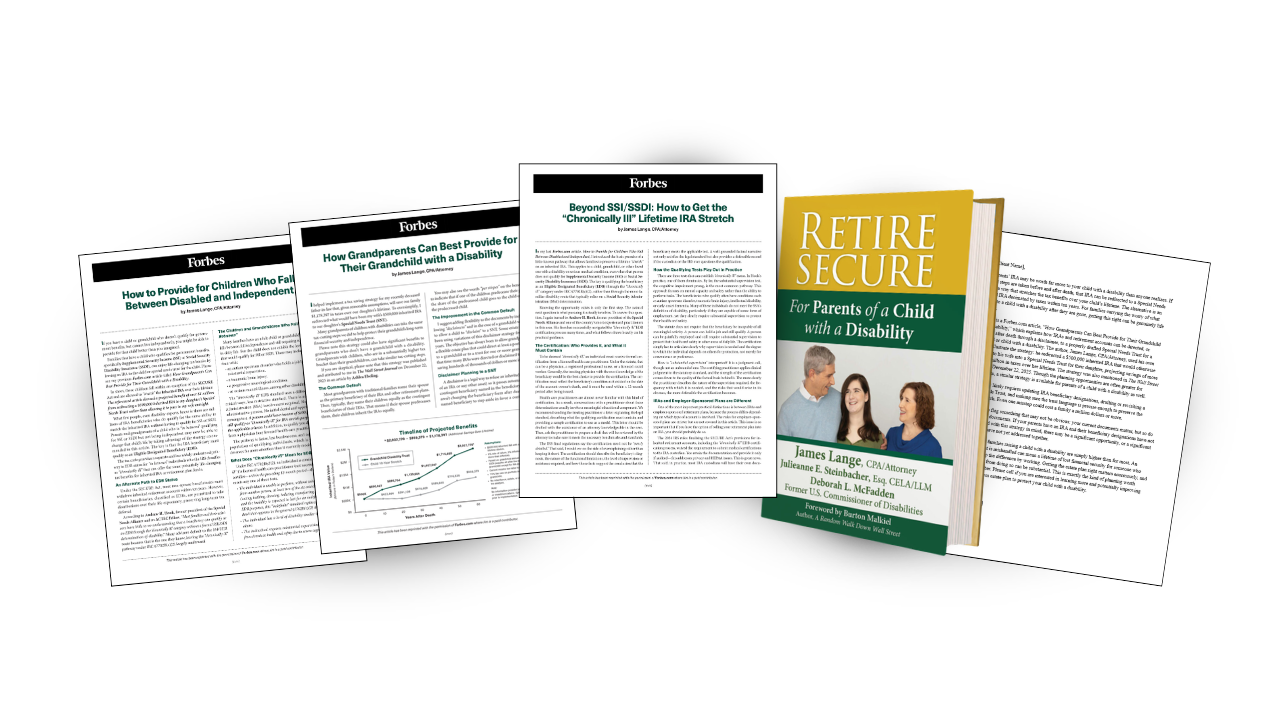
- A complimentary hardcover copy of Jim’s book, Retire Secure for Parents of a Child with a Disability (while supplies last).
- Digital reprints of Jim’s Forbes.com articles on EDB planning, including:
- How Grandparents Can Best Provide for Their Grandchild with a Disability,
- How to Provide for Children Who Fall Between Disabled and Independent, and
- Beyond SSI/SSDI: How to Get the Chronically Ill Lifetime IRA Stretch.
- Hook’s Chronically Ill EDB Planning Guide & Certification Template Package: This comprehensive package provides the practical tools that families and their advisors need to identify, document, and pursue the chronically ill pathway to EDB status. This is a sleeper bonus, and it is incredibly helpful if your beneficiary could possibly qualify under the chronically ill exception. It is Andy’s internally developed intellectual property that he is distributing freely to attendees.
The example cited and any tax savings referenced are for illustrative and educational purposes only and do not represent a guarantee of results. Individual outcomes depend on many factors, including the size of the inherited IRA, future tax laws, trust design, and personal circumstances. This webinar is educational and does not constitute tax, legal, or investment advice. Lange Financial Group, LLC is an investment advisory firm registered with the Commonwealth of Pennsylvania Department of Banking.