To illustrate the life-changing difference between pro-active and passive planning for your child with a disability, I am sharing my family’s personal story. Our daughter, Erica, has a disability and will never be able to support herself unless there is an unforeseeable significant change in her condition. She is currently receiving SSDI. One of the most important things for me and my wife, as it is for practically all parents of a child with a disability, is to ensure we properly provide for our child while we are alive and, perhaps even more importantly, after we are gone.
Let’s Start at the End of the Story
Because of our actions on three critical fronts, our daughter will be $1,890,544 better off (measured in today’s dollars) than she would have been had we not taken these proactive steps, and this is without factoring in any supplemental government benefits. A secondary consequence is that my wife and I will also be better off by $491,829.
The three things we did were:
- We made a large Roth IRA conversion and a series of Roth IRA, backdoor Roth IRA, and Roth 401(k) contributions.
- We won our Social Security Disability Insurance (SSDI) appeal with the Social Security Administration (SSA) formally establishing Erica’s status as disabled.
- Our attorney drafted an optimized estate plan with appropriate wills, trusts, and IRA and 401(k) and Roth IRA beneficiary forms that will allow Erica to “stretch” or defer distributions of her Inherited IRA or Inherited Roth IRA.
We are also setting in place measures to ensure our estate will be appropriately administered after we die. A key measure was to establish Erica’s status as an eligible designated beneficiary. That will ensure she will be able to “stretch” her Inherited Roth IRA.
Why Is EDB Status So Important?
As I described in Chapter 10, one of the consequences of the 2020 SECURE Act was the end of the stretch IRA. Before the SECURE Act, when someone inherited an IRA or other retirement plan, they could take distributions over their entire lifetimes. That meant that IRA or retirement plan assets could grow tax-free, in the case of Inherited Roth IRAs, or tax-deferred for decades. But under the SECURE Act, unless a beneficiary qualifies for one of a few exceptions, Inherited IRAs and other retirement plans must be entirely distributed within 10 years of the original owner’s death, resulting in a massive income tax acceleration.
Fortunately for parents of children with disabilities, when the beneficiary qualifies as disabled or chronically ill with the SSA and the IRS, they become an Eligible Designated Beneficiary (EDB). Any EDB who inherits an IRA, Roth IRA, or other retirement plan can still take full advantage of the stretch IRA, which can make a tremendous difference in the amount of money that person has access to over their lifetime, as I demonstrate below.
Figure 11.1 demonstrates the dramatic contrast between Erica’s current projected financial future, the consequence of our effective planning (using Roth strategies, qualifying her as an EDB, and optimizing our estate plan), and the future she might have had with ineffective planning. It begins with our (mine and my wife’s) projected deaths when she is age 46 and continues to her projected death at age 86.
You can find the complete list of very reasonable assumptions we used to make these calculations in the Appendix. It is important to know that we factored the money we paid in taxes on the Roth conversion as well as the resulting loss of growth on that money into these calculations.
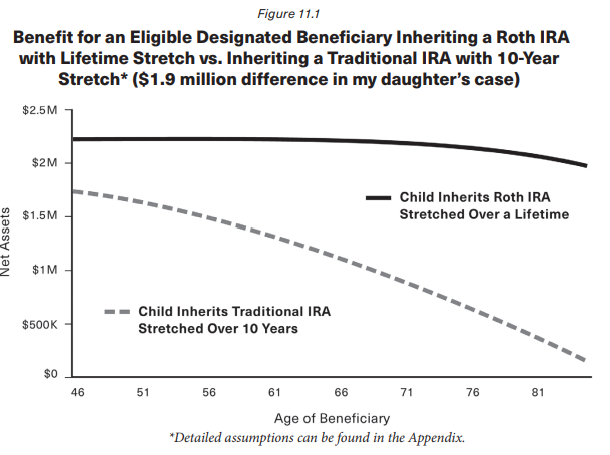
These projections represent a true “apples to apples” comparison. The bottom line is that had we not taken these proactive measures, at age 86, Erica would be broke but because we did, she will still have a comfortable $1,890,544 (measured in today’s dollars). Or more to the point, she will be able to spend much more money over the course of her life and still not worry about running out of money. She will be able to afford many more services and a much better lifestyle, both for her health and comfort, in ways that would have otherwise been impossible. She will not have to worry about money, and now neither Cindy nor I worry about her financial security after we are gone.